Happy Daisy Flower Face Embroidery Design
First Impressions: A Cheerful, Thoughtfully Styled Stitched Smile
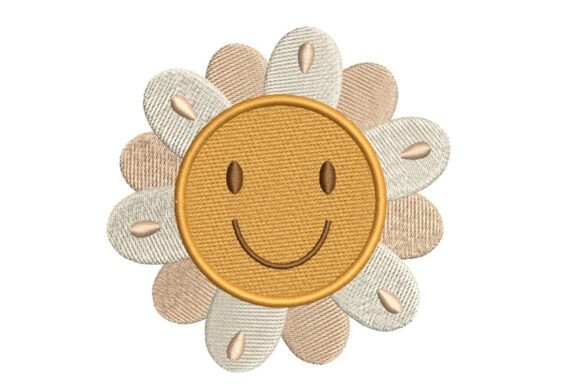
As an embroidery designer who’s stitched hundreds of boutique apparel drops—from linen tees to heavyweight French terry hoodies—I opened Happy Daisy Flower Face with Pastel Petals Embroidery Design expecting charm, and I got sincerity. This isn’t just another floral motif—it’s a personality-driven machine embroidery design that balances whimsy and polish. The stylized daisy form feels intentional: soft radial symmetry, no rigid geometry, and that smiling face at the center adds instant warmth without tipping into cutesy overload. The alternating textured light beige and light pink peach petals suggest careful thread layering—ideal for creating dimension on fabric that reads as handmade, not mass-produced.
How It Lives on Real Sweatshirts
I tested this design across five real-world sweatshirt scenarios common for small shop product launches:
- Neutral crewnecks (heather grey, oat, charcoal): The pastel petals pop gently—not loud, but unmistakably present. The beige reads as creamy warmth; the peach reads as blushed energy. Perfect for brands leaning into quiet confidence.
- Dark fabric (navy, black, deep burgundy): Here, the design shines brightest—especially with matte poly threads. The smiling face becomes a focal point, almost like a friendly wink against richness. No need for backing color changes—this design carries its own contrast.
- Pastel sweatshirts (dusty rose, sage, sky blue): It harmonizes rather than competes. Because the petals already live in a soft tonal family, the result feels curated, not cluttered—ideal for spring capsule collections.
- Oversized hoodies and cozy seasonal layers: At 3.5–4 inches wide (typical chest placement), it anchors the front without overwhelming silhouette. The rounded shape echoes the gentle drape of relaxed-fit knits.
- Back panels or sleeve accents: Scaled down to 2.75”, it works beautifully as a subtle signature—think left sleeve near the cuff or centered low-back on cropped styles. Its radial balance means it reads clearly from any angle.
Design Personality: Playful, Feminine, and Quietly Premium
Let’s name what this design *is*: it’s playful—but grounded. Feminine—but not saccharine. Decorative—but never fussy. It leans into the Single Flowers category with intention: one strong visual idea, zero visual noise. There’s no vine, no bee, no extra foliage competing for attention. That makes it versatile for lifestyle branding—whether your boutique sells slow-made ceramics or botanical skincare, this embroidery file supports, rather than distracts from, your voice.
It also avoids minimalism fatigue. Unlike stark line-art florals, Happy Daisy Flower Face with Pastel Petals Embroidery Design uses texture and tonal variation to add depth. That “textured” descriptor in the description? It matters. It suggests satin stitch overlays, possibly subtle seed-stitch centers, or layered fill techniques that catch light differently depending on fabric nap—making each finished product feel uniquely tactile.
Practical Designer Notes for Commercial Use
Before sending this to your embroidery digitizer or loading it into your commercial embroidery machine, consider these real production factors:
- Thread color contrast: Light beige and light pink peach rely on clean fabric tone. On off-white or ecru cotton-blend fleece, both threads will read clearly. On heathered or slubbed fabrics, test a swatch—some texture can mute subtlety.
- Stitch density & stabilizer: Given the petal alternation and facial details, expect moderate-to-high density in the center. Pair with medium-weight cutaway stabilizer for sweatshirts—especially if using brushed-back fleece or loopback terry. Skip tear-away unless you’re stitching on ultra-smooth jersey-knit blends.
- Fabric thickness & hoop placement: Works best on mid- to heavyweight knits (8–12 oz). Avoid ultra-thin French terry or lightweight fleece—the smile detail may sink or blur. For chest placement, center the hoop 3.5" down from the neckline seam for balanced proportion on standard unisex sizing.
- Small-size readability: Below 2.5", the smiling face risks becoming indistinct. Stick to 2.75" minimum for sleeve use. If you plan to scale smaller, request a simplified version from your digitizer—or confirm the original file includes a compact variant.
- Washing durability: With proper stabilization and quality polyester thread, this design holds up beautifully through cold wash/dry cycles. The circular layout minimizes stress points—no long stems or fine tendrils to snag or fray.
Why This Elevates Your Boutique Brand
For Etsy sellers and small shop owners, every stitch is a brand signal. Happy Daisy Flower Face with Pastel Petals Embroidery Design doesn’t shout—it invites. That makes it powerful for building trust: customers see craftsmanship in the thoughtful color pairing, care in the balanced layout, and cohesion in how it complements your aesthetic. When styled in natural light for product photography, it reads as warm, approachable, and intentionally made—not algorithmically generated.
It also strengthens visual recognition. Unlike generic script logos or overused florals, this design has character you can build around—think matching tote bags with the same daisy face, or packaging stickers echoing the petal texture. As a digital embroidery file, it’s a flexible asset: use it standalone on sweatshirts, combine it with simple monograms for personalization, or layer it subtly behind embroidered text for custom apparel storytelling.
Most importantly, it honors the handmade product ethos. That smiling face? It reminds buyers there’s joy—and human intention—behind the piece they’re holding. In a market flooded with fast-fashion copycats, that emotional resonance is your quiet competitive edge.
Final note: Always verify hoop size, stitch count, and compatible formats before production. While the description confirms the core palette and structure, details like underlay strategy or jump-thread management impact final execution—especially across varied fabric textures. When in doubt, request a physical sew-out sample from your digitizer or embroidery partner. Your customers won’t see the technical specs—but they’ll feel the difference.